Erden is going public, by invitation

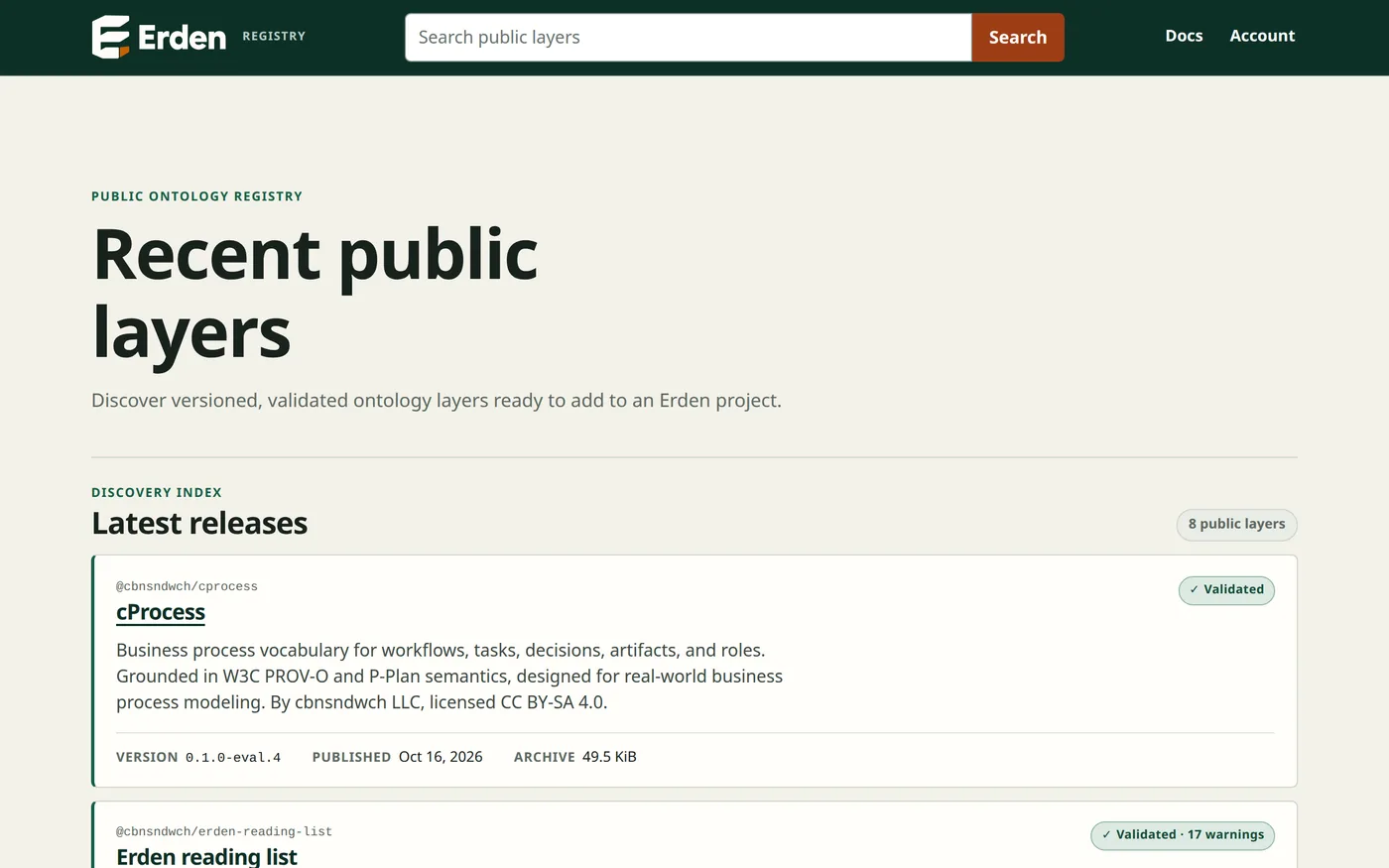
The Erden registry home page, listing recent public ontology layers
Since August, the Erden registry has only run on an internal deployment. Every release in it has been checked, and every screenshot on erden.sh comes from an evaluation build, but nobody outside has been able to depend on any of it.
That's about to change. I'm almost ready to deploy the registry publicly, in invite-only mode. I don't have a date to give you yet, but I'd rather explain what it means before it happens.
What invite-only means
Reading is open. Public projects will be searchable and downloadable without an account. If the point of a release is that anyone can inspect its evidence, the evidence can't sit behind a login.
Publishing is by invitation. There's no open sign-up. Accounts get created deliberately, starting with research and design partners.
Projects can be public or private. A private project is only readable by its organization's members and the people it's been shared with.
It's still pre-1.0. These are evaluation builds with a documented part of OWL behind them, not a finished product. Going public means other people can reach it. It doesn't mean it's done.
Why this step is different
An internal deployment is forgiving. When only I depend on something, I can reset it, rename things and start over, and the only person inconvenienced is me.
The whole premise is that a published release can't change and that other work can pin to it. That promise doesn't mean much until there's someone else on the other end of it. Once outside ontologies are in the registry and outside projects depend on them, I can't take back a release that turns out to be inconvenient. That's the point, and it's also why I've kept this behind a door until now.
Invitations let me make that promise to a small group first, with people I can talk to directly, while I learn what it costs to keep.
What I expect to go wrong
The last time real domain models met these tools, they found plenty, and outside ontologies will find more. I expect reasoner coverage to be the first wall people hit, because every project relies on some OWL construct I haven't prioritized yet. That's useful, and it's why the partner form asks what you'd bring.
The harder questions will stay open for a while. Erden still won't tell you whether a change is breaking, and the interface for AI agents stays off by default until partners ask for it. I'd rather leave those open than settle them before the people affected have had a say.
Before it opens
Partners will need an installer rather than a source build, so the first public release of the open source CLI is being prepared alongside this.
If you work with ontologies and want to be in that first group, the form is open now. I read every request myself.
I'll post here when the registry is live.