
Fractals, Fractional Dimensions, and a Personal Journey

Fractal Geometry
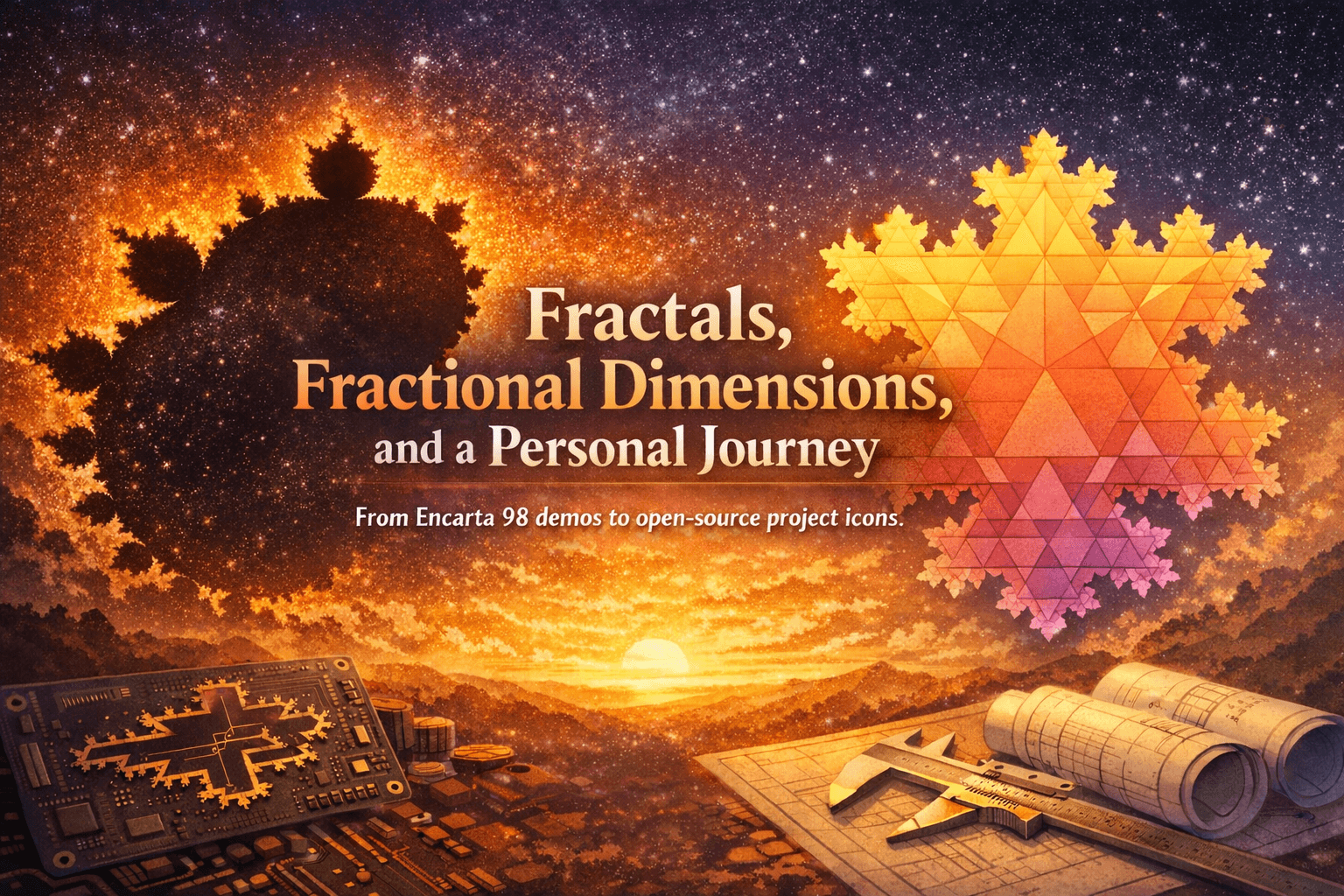
I still remember the first time I encountered a fractal. It was the late 90s—I was maybe 8 years old—poking around Microsoft Encarta '98 on CD-ROM when I stumbled on a little interactive demo. It zoomed into the Mandelbrot set, and as it zoomed, there were more patterns. And inside those, more patterns. Endless. I had no idea what I was looking at, but I was completely hooked. That moment stuck with me.
To this day I'm still entranced by them, so I've decided to start using fractal shapes as icons for my open-source projects. Why? They look awesome, and they embody one of the ideas I love most about human ingenuity:
From humble beginnings come great things
But fractals aren't just pretty patterns. They embody a profound idea: fractional dimension. Unlike a line (1D) or a plane (2D), a fractal can be something in between. The Sierpinski triangle, for example, has a dimension of about 1.585—not quite a line, not quite an area.
This self-similarity is one of the key aspects that give these types of fractals their infinite complexity. It also turns out to be incredibly useful.

A Koch snowflake after 7 iterations—generated with my
Fractal SVG Generator
Where Fractals Meet Engineering
Here's a quick tour of how fractal geometry shows up in real-world applications:
Antenna Design — Shapes like the Koch snowflake let engineers pack a very long electrical pathway into a small physical space. The result: compact antennas that resonate at multiple frequencies simultaneously. Crack open a smartphone and you might find a zig-zaggy fractal pattern on the circuit board.
Thermal Management — Hilbert curves snake through compact areas without self-intersecting, maximizing surface contact for heat transfer. Researchers have 3D-printed fractal heat exchangers that outperform traditional designs.
Structural Engineering — Sierpinski-based trusses distribute loads hierarchically, increasing strength-to-weight ratios dramatically. Big implications for aerospace where every gram counts.
Manufacturing — Some 3D printers use Hilbert curve infill patterns, tracing a single continuous path rather than separate lines. Faster prints, more uniform structure, better strength.
Medical Imaging — Fractal dimension helps quantify irregular patterns in tissue—useful for detecting early-stage tumors or analyzing blood vessel networks.
What's Next
This post kicks off a series diving deeper into each application. Upcoming topics:
- Wireless & Antennas — Specific fractal designs and performance gains
- Thermal Systems — 3D-printed fractal heat exchangers
- Structural Engineering — Sierpinski trusses in aerospace
- Manufacturing — CNC toolpaths and 3D print optimization
- Medical Imaging — Fractal analysis for diagnostics
- Art & Design — Generative art with my Fractal SVG Generator
Did you have a favorite fractal screensaver growing up? Know of other cool fractal applications? Hit me up on X/Twitter.
Cheers to fractional dimensions and never-ending patterns!